v.
Fellowship & Social
Towns are peopled and players organise: guilds with roles, alliances and a shared bank, parties, seven chat channels with dialogue bubbles, and moderation that keeps the community safe.
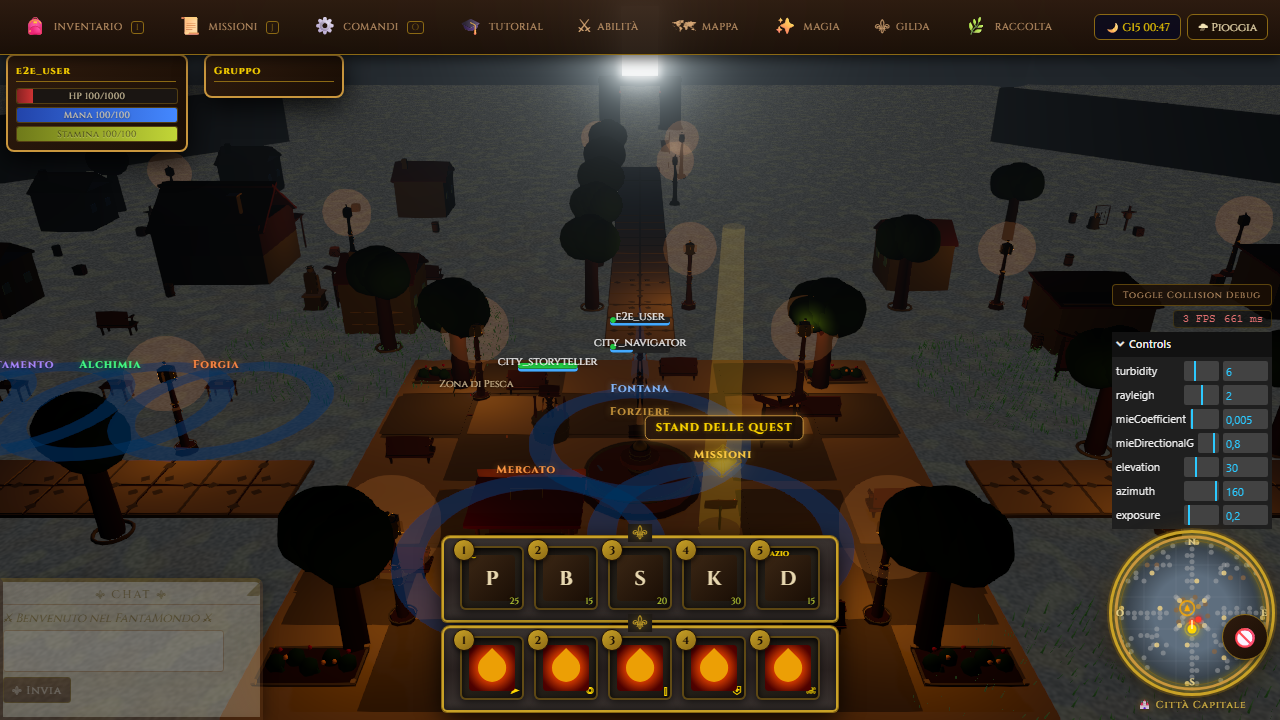
A town isn’t a backdrop. It’s people who remember your name — and what you did.
A town isn't a backdrop: it's people who remember your name — and what you did. The squares are peopled by other players and by NPCs with personality, standing at the landmarks as true entities, not silent vendor statues. And when you talk to them, some answer in real time: their lines are generated by an LLM from their character and your name, in character, and they remember you.
Above the individuals, players organize. Guilds are small institutions with a shared bank, ranks and sensible permissions — and an endgame of their own: capture and fortify contested outposts, besiege a rival's walls, and climb a seasonal prestige ladder toward a walled city you build together. Parties form on the fly for tougher content; seven chat channels — local, global, guild, alliance, party, whisper, trade — plus speech-bubble dialogue above your character. There is even a guide NPC that, with the manual as a knowledge base, answers your questions about the game while staying inside the fiction.
And so the community stays livable, moderation that protects: reports by category, mutes enforced by the game, and the ability to always see which sanctions apply to you.
The features
-
Guilds (roles, permissions, alliances)
You found a guild with a name, a 4-letter tag and a category (PvP/PvE/crafting/exploration/social), or browse and request to join. It includes a shared bank, custom roles with granular permissions, a guild chat — and inter-guild alliances with a shared chat channel, friendly fire off and joint outpost captures.
Find your people — a guild gives you a tag, an identity, a treasury with real permissions, and allies to fight beside.
Playable now -
Parties
You form a temporary party: invite via toast, accept/decline, kick or leave. The party opens a dedicated chat channel, keeps every member’s vitals on screen, and splits gathering XP between the companions standing within forty metres of whoever swung the pick — one pot divided, so a bigger party never mints more XP than the world produced.
Group up on the fly for tougher content with shared chat and party-only activities.
Playable now -
Chat channels and dialogue bubbles
Seven channels (local, global, guild, alliance, party, whisper, trade) with slash commands, plus speech-bubble dialogue above your character for the local channel.
Layered communication — shout to the world, whisper in private, or bubble-chat with whoever is beside you.
Playable now -
Reports and moderation
You report abusive messages by category; moderators can delete messages, time out, chat-ban or game-ban, and the game enforces active mutes. You can see the active sanctions against you.
A safer community: bad actors get reported and silenced, and you always know which sanctions apply.
Playable now -
Dialogue NPCs with personality
Town and landmark NPCs (quest givers, storytellers, ambient townsfolk) carry personality traits that colour their dialogue and stand near landmarks as true entities (invulnerable).
Towns feel peopled — characters with personality, not silent vendor statues.
Playable now -
NPCs with LLM-generated dialogue
When you talk to certain NPCs, their lines are generated in real time by an LLM based on their personality, the conversation state and your name; they answer in character and remember past interactions.
NPCs don’t repeat the same 3 lines: they respond vividly and in character to what you say.
Playable now -
Guide NPCs with a knowledge base
Some NPCs answer open questions about the game using the manual as a knowledge base: ask “how does X work” and the NPC replies in character with real info, keeping continuity with earlier interactions.
An NPC acts as a living guide: it explains the game while staying in the fiction, and remembers you.
Playable now -
Notifications, mail and commission board
An in-game notification inbox (unread, mark-read, delete), a player mail system with redeemable attachments (system mail can carry rewards), and a board where you post commissions with a coin bounty that others accept.
Reach others asynchronously, claim rewards by mail, and turn the playerbase into your bounty workforce.
Playable now -
Capturable outposts and sieges
Guilds capture contested outpost altars and hold them; owners fortify with segmented walls, a gate and towers, each with their own hit points, and rival guilds besiege them to take over. Territory changes hands through real construction and destruction.
Guild endgame with real territory — capture, fortify and besiege outposts, not just a leaderboard.
Playable now -
Prestige ladder and walled city
Holding outposts earns a guild Prestige, ranked on a seasonal ladder; a multi-tier walled city is raised through construction — depositing materials to build up walls, gates and towers over time.
Build a fortified guild city and climb the season’s prestige ladder.
Playable now -
Outpost modules, barracks and camps
A captured outpost is built out module by module from deposited materials: barracks where officers store shared gear, and staked camps that radiate XP and yield bonuses to everyone of your colours standing in them.
An outpost your guild actually builds, stocks and gains from — not just a flag you hold.
Playable now -
Defence windows and scheduled sieges
Every outpost declares a four-hour window in which it can be taken — 19:00 UTC until its guild moves it, and it may only move once every three days. A capture attempt outside that window schedules a siege instead of taking the altar, warns the holding guild in its own language, and runs into an armoury that doubles the defenders off-hours. A freshly founded outpost is immune for its first 24 hours.
Territory changes hands at an hour your guild agreed to be awake for, not while it sleeps.
Playable now
Current state
All eleven features are playable now: guilds, parties, chat channels and dialogue bubbles, reports and moderation, NPCs with personality, NPCs with LLM-generated dialogue, guide NPCs with a knowledge base, the notifications, mail and commission-board system, capturable outposts and sieges, the prestige ladder and walled city, and outpost modules, barracks and camps. The social life is fully live.