— the whole index —
The Compendium
Every system, every feature, the status declared.
This is the honest inventory of Vellum. Not a showcase of promises, but the full list of what the game actually does — seven systems, and under each one all the features that make it up, described for what they are.
Beside every feature there is a label, and the label does not lie: every feature listed here is Playable now — you can try it today. Nothing is inflated, nothing is hidden. Open a system and step in.
-
i.
Combat
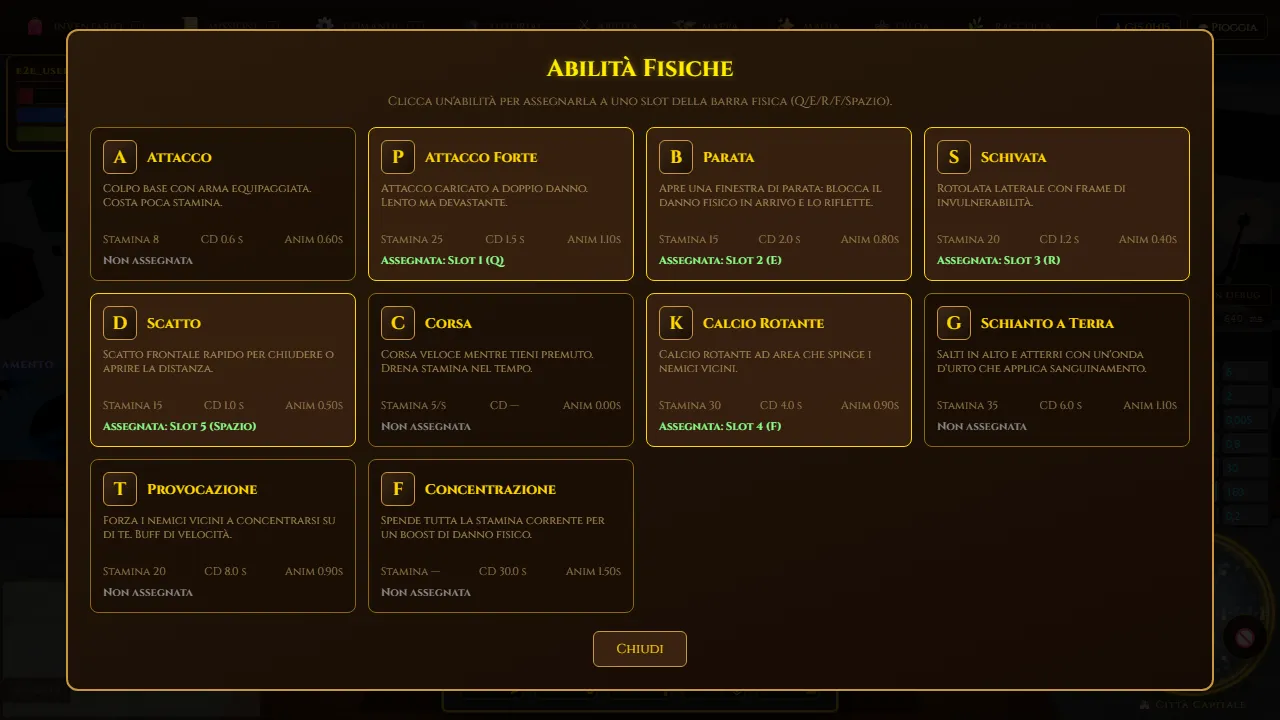
Every blow is aimed, every spell a real physical object: position, timing and reading your foe decide the fight — not a locked target.
Open →
-
ii.
Crafts & Gathering
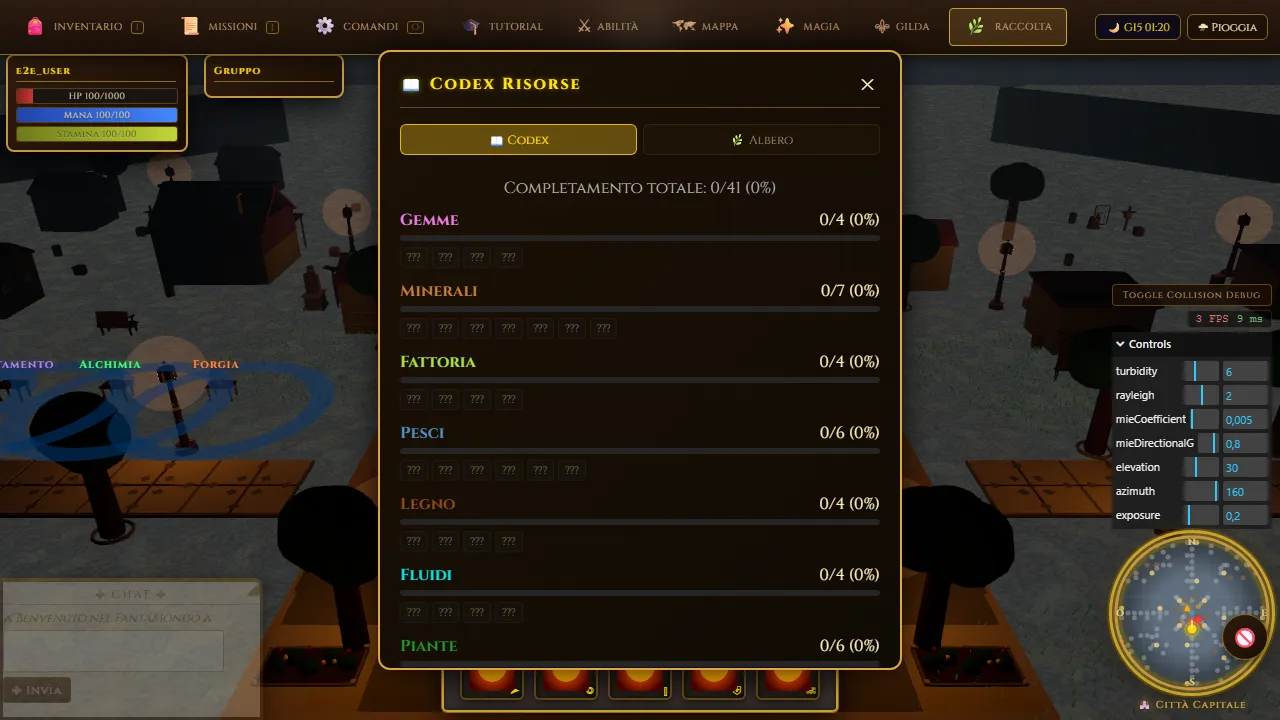
From the ore vein to the finished blade: an Albion-style production chain where every raw material has its own line.
Open →
-
iii.
Exploration & World
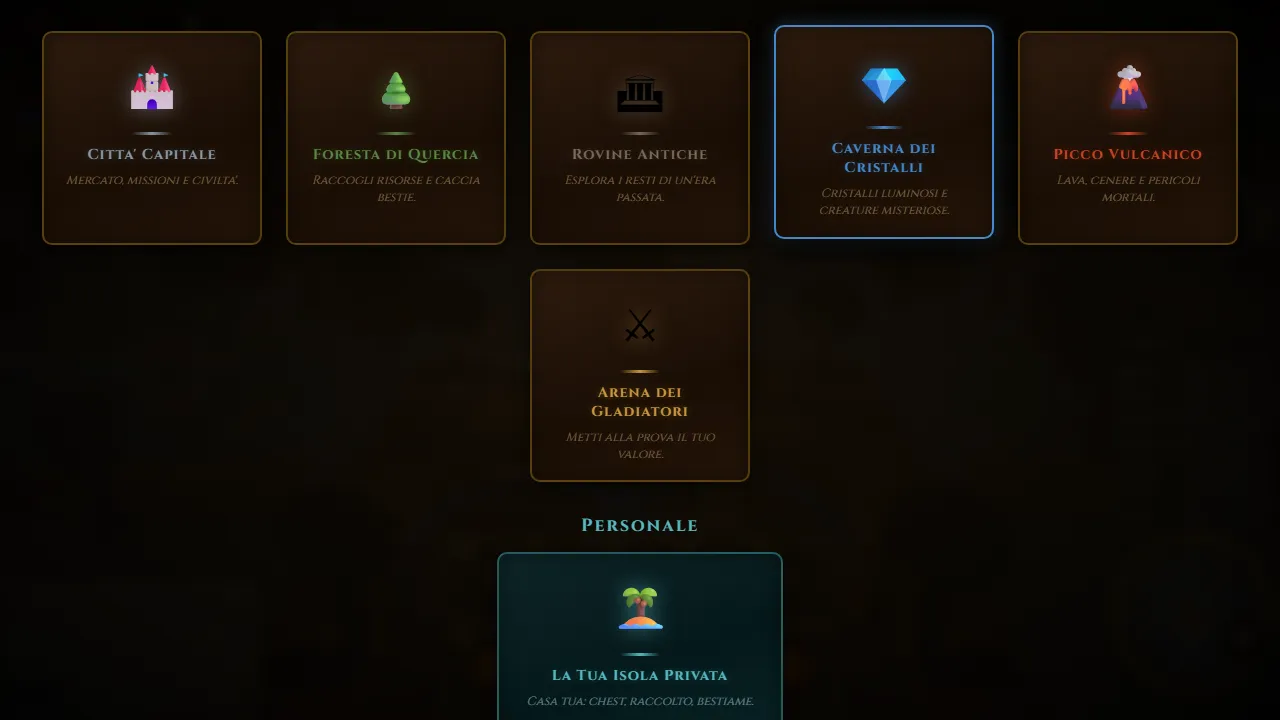
A browser-native 3D world that breathes: six zones joined by physical doors, day/night, weather and peaks to climb.
Open →
-
iv.
Economy & Markets
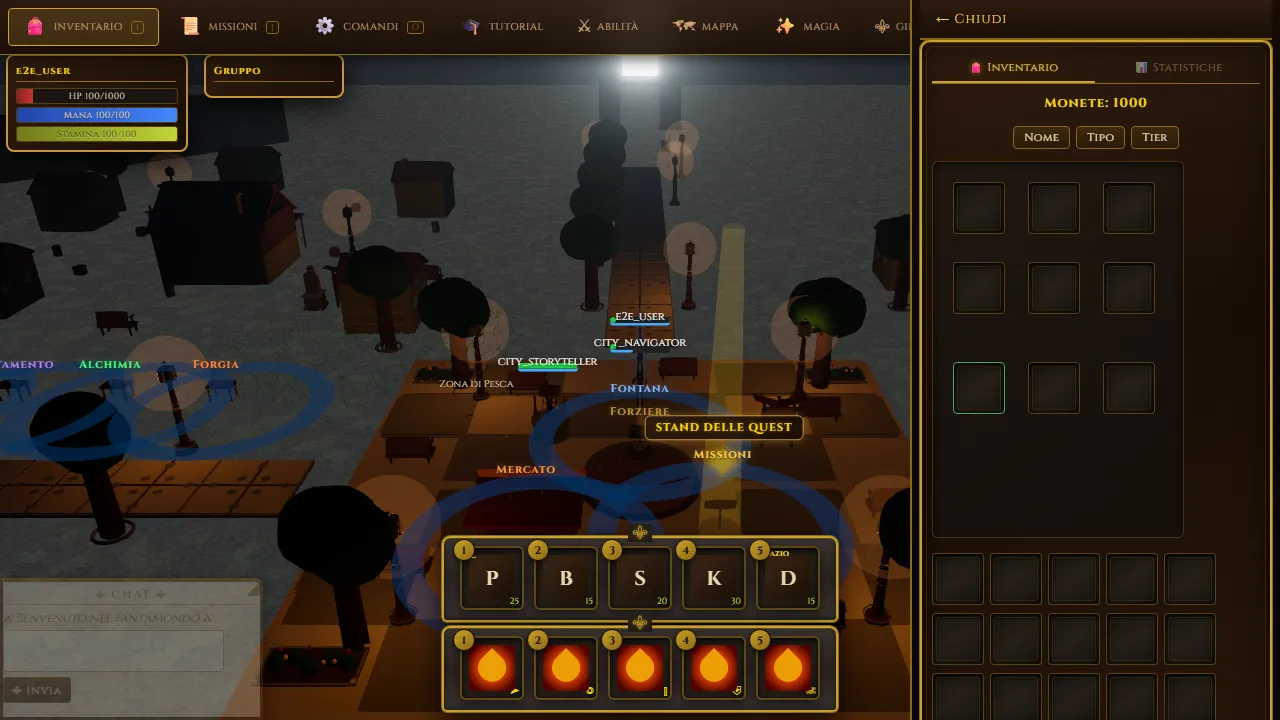
A real player economy with an order book, price history and anti-inflation taxes — every coin has a faucet and a sink.
Open →
-
v.
Fellowship & Social
Towns are peopled and players organise: guilds with a shared bank, parties, seven chat channels and moderation that keeps it safe.
Open →
-
vi.
Progression & Character
No character level: you are the sum of what you do. Seventeen separate skills, per-ability progression, and a magic trait tree.
Open →
-
vii.
Account & Home
Your foothold: a persistent account with a subscription, a private island to build, and controls tuned to play anywhere.
Open →
i. Combat
Every blow is aimed and every spell is a real physical object: the martial and arcane craft of Vellum rewards position, timing and reading your opponent, not a locked-on target.
-
Skillshot weapon combat
Aimed real-time combat: you point each strike at a position and the server resolves who gets hit using cone, line or circle shapes. No auto-attack on a target.
Playable now -
Elemental magic
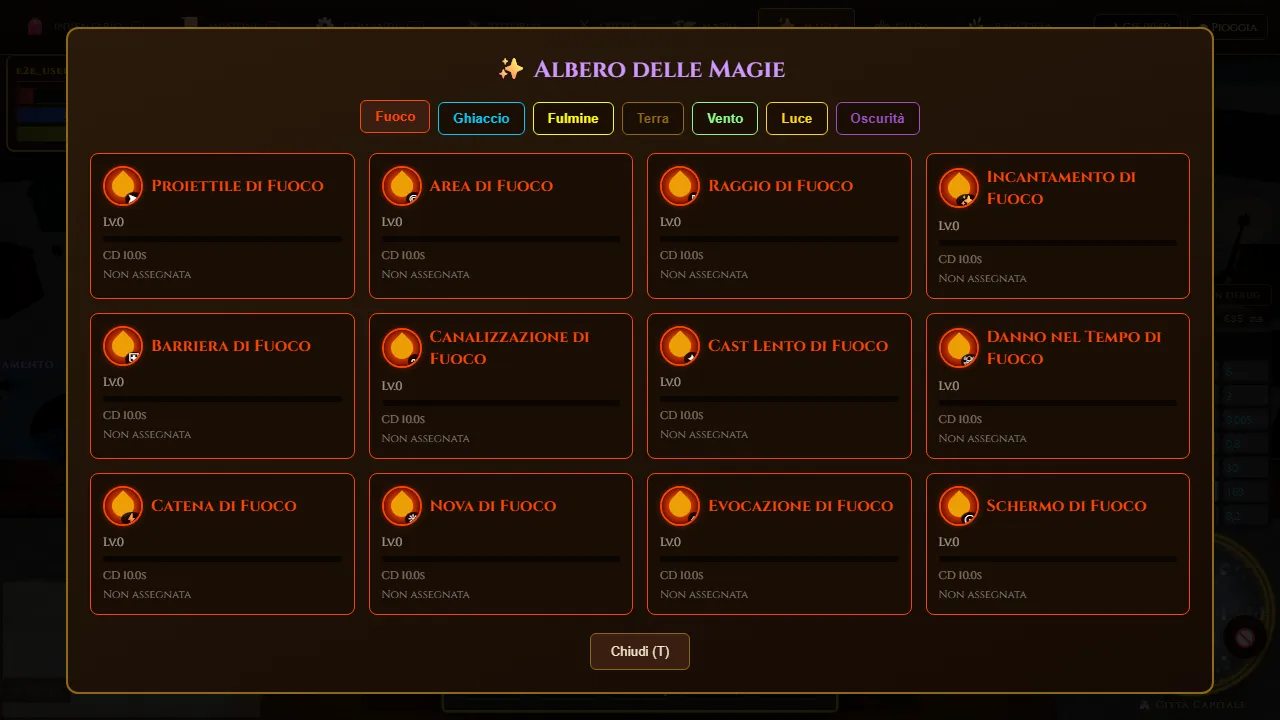
You cast directional spells across 9 elements (fire, ice, lightning, earth, wind, light, dark, nature, arcane) that fly as projectiles, areas, beams or zones, simulated entirely server-side. 90 base spells.
Playable now -
PvP zones and wager duels
Open-PvP zones let players fight each other, while safe zones stay peaceful — one server-side rule decides who can be attacked where. Anywhere, you can challenge a nearby player to a 1v1 wager duel: both stake coins, and the winner takes the pot.
Playable now -
Stamina physical abilities
Stamina-cost action abilities bound to the hotbar: Heavy Attack, Parry, Dodge, Dash, Ground Slam, Spin Kick, Taunt, Focus, plus Sprint. They have i-frames, parry windows and movement impulses, and level with use.
Playable now -
Status effects (DoT and control)
Combat applies stacking states: poison/burn (which spreads to nearby enemies), bleed, freeze with a shatter bonus, weaken, haste. Crowd control has diminishing returns.
Playable now -
Support magic (heal and shield)
Spells that target allies: Nature healing (regeneration over time) and a Light barrier (absorbing shield), with ally targeting. Ability cards read “Heal: X” or “Shield: X”.
Playable now -
Spell crafting (spell craft)
At the Arcane Forge you fuse two source spells into a new custom spell that you own, which joins the game’s definitions under your signature and levels up like any other.
Playable now -
In-combat consumables
You use consumables in real time (healing potions, haste draughts, antidotes, strength/defence/speed elixirs, buff foods) that heal, apply or remove states, or grant temporary buffs mid-combat.
Playable now -
Combat feedback (VFX, damage numbers, nameplates)
Floating damage numbers, impact VFX, a row of status effects with timers, and a single per-entity nameplate carrying name, guild, HP bar (with shield) and mana bar, readable from any angle.
Playable now -
Wave instances (horde mode)
Instanced horde runs where a difficulty director escalates each wave, mixes in elites and scales to the size of your group, handing out gear tiers as the waves climb.
Playable now -
Downed state, revive and respawn points
Dropping to zero puts you in a downed state instead of killing you outright: an ally can channel a revive, and if nobody reaches you, you choose which attuned outpost to wake at.
Playable now
ii. Crafts & Gathering
From the ore vein to the finished blade: an Albion-style production chain where every raw material has its own refining line and every craft skill matters.
-
Gathering (mining, woodcutting, herbalism)
Node-based gathering for ore, wood and herbs: you need the right category and tier of tool, gathering luck rolls the node’s bonus-drop table for extra materials, and tools wear down.
Playable now -
Fishing minigame
Active three-phase fishing: you cast the line, wait for the bite, then hook within a reaction window that widens with skill. Mistime it and the fish gets away.
Playable now -
Creature skinning
You skin the carcasses of slain beasts with a tiered skinning knife to recover hide, bone, fangs, feathers and raw meat from drop tables weighted by the creature’s tier.
Playable now -
Farming (farm plots)
You plant seeds in the plots on your island, wait out real growth cycles (5-20 min), optionally tend them for a bonus yield, and harvest grain, cotton, vegetables and fruit.
Playable now -
Multi-step crafting at benches
155 recipes across multiple benches (furnace, loom, tannery, lab, smithy). Each recipe requires a skill level and ingredients, consumes them, produces the output and awards XP. Recipes chain: raw → ingot → weapon.
Playable now -
Refining and alloys (the mineral world)
Raw resources refine into materials through dedicated skills — smelting, woodworking, weaving, tanning, masonry. The SP4 overhaul made alloys and ores realistic (copper+tin → bronze, iron+coal → steel).
Playable now -
Weapon forge (combination moves)
A station where you fuse two weapon traits, consuming ingredients to create a combined weapon scroll that unlocks unique end-game weapon moves.
Playable now -
Consumables (potions, elixirs, buff foods)
15 alchemy recipes — three intermediates plus 12 finished consumables: healing potions, haste draughts, antidotes, and strength/defence/speed/resistance elixirs.
Playable now -
Durability and repair
Weapons and armour wear out over a 0-100 durability pool; gathering tools have their own, much wider pool that scales with the tool. You repair by paying coins — your smithing level shaves up to 50% off the bill — or by spending the recipe’s own ingredients, in proportion to the damage.
Playable now -
Animal husbandry (livestock pens)
You buy livestock (hen, sheep, cow, pig) at the pens on your island, feed them on a timer so production never stalls, and the animals age, can become pregnant, give birth and grow. They are true server-side entities.
Playable now -
Live-capture taming
You craft nets, throw them at a weakened wild beast and hold it while a taming meter fills, feeding it what its species prefers to keep the meter from decaying. What you bring home is a tamed animal, and it is the only way to get one.
Playable now -
Coin cost on high-tier crafting
Forging from tier 3 upward costs coins on top of the materials — 25 at bronze and silver, 60 at steel, 80 at fine leather, 100 at mithril. Starter and iron gear stay free.
Playable now
iii. Exploration & World
A browser-native 3D world that breathes: six hub-and-spoke zones joined by physical doors, a day/night cycle, weather, and peaks to climb.
-
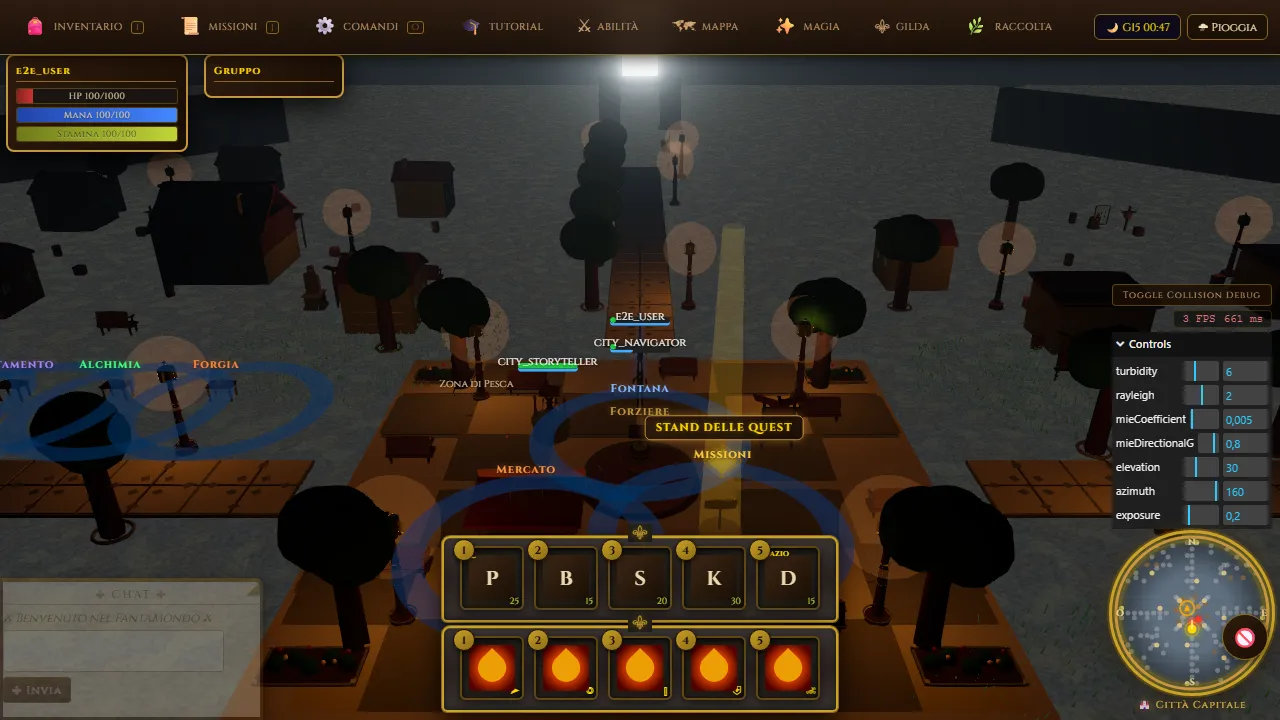
Browser 3D world (Three.js)
A real-time 3D MMORPG rendered in the browser: you see your character, other players, NPCs, animals, buildings and resources across themed zones, with a wide camera, fog and LOD so distant landmarks stay visible.
Playable now -
Zones, doors and zone selector
A hub-and-spoke world of 6 zones (capital + forest, ruins, arena, crystal cavern, volcanic peak) joined by paired doors; stepping through a door transfers you to the twin door in the next zone.
Playable now -
Global map and unlockable fast-travel
A world graph map (F key) draws the zone graph in SVG: visited zones are clickable for fast-travel gated by visit and cost, the current one is highlighted, and unvisited ones are locked.
Playable now -
Walkable verticality
Extended verticality — the ruins’ platforms, stairs and ramps and the capital’s raised structures, all held up by real collision bodies you can walk and fight on.
Playable now -
Day/night cycle and weather
A server-authoritative day/night cycle (24 real minutes = one game day) and a per-zone, state-based weather system (clear, rain, storm, fog, snow, ash) broadcast to every player.
Playable now -
Environmental hazards and altars
World hazards like lava pools deal periodic damage, and arcane time-dilation fields slow anyone who enters; interactable crystal altars grant timed buffs (minor heal, magic power, defence).
Playable now -
Cinematics
In-engine cinematic sequences with letterbox bars, a speaker dialogue box, fades and a skip hint, used for story moments. You watch them or skip them.
Playable now -
Rideable mounts
Summon and ride a mount to cross zones faster; mounting swaps your movement and aiming, the mount is rendered beneath you, and you dismount on demand.
Playable now -
Roaming wildlife
Animals are not props pinned to a spot: each is born wherever the ground is free and then wanders inside a home territory it keeps returning to. Every zone carries its own roster — forty-eight beasts across seven species in the forest, from rabbits up to bears and the great stag, wolves and foxes in the ruins, cave spiders in the crystal cavern, lava worms on the volcanic peak.
Playable now -
A world with a voice
Every sound is synthesised in the browser instead of streamed from a sample library: 95 one-shots for blows, spells, tools, doors and the interface, placed in space with a falloff that scales down with your quality tier. Footsteps change with the ground under you across eight terrain palettes, hooves with the beast you ride, and each zone carries its own music and ambient sources, positioned by the server.
Playable now
iv. Economy & Markets
A real player economy with an order book, price history and anti-inflation taxes — gear flows toward whoever values it most, and every coin has a faucet and a sink.
-
Auction house (sales and buy orders)
A 4-tab market gated by proximity to a stall: you browse listings filtered by category and sorted by price, sell by drag-and-drop, place buy orders that fill themselves when a seller appears, and manage your own. Every row names the player selling it, and coins and items change hands automatically.
Playable now -
Market taxes and price history
Every market action takes a small cut (5% broker, 3% listing, 2% cancellation) that destroys coins, plus a per-item price history you can consult to judge a fair price.
Playable now -
Offline deliveries (settlement)
When a listing sells or an order fills while you’re away, coins or items are queued and delivered safely on your next login.
Playable now -
Black market (gear sink)
A proximity-gated NPC counterpart that BUYS what the world consumes — gear, raw materials, potions — for minted coins, under a daily cap: the goods leave the world and come back re-equipped or drunk by the NPCs you might face.
Playable now -
Player-to-player trade
A direct trade window between two nearby players: each side offers items and coins, both must confirm, and the swap happens atomically.
Playable now -
Inventory and item provenance
A 40-slot inventory where items stack, move/split/merge/sort and carry the maker’s label (“Made by: <name>”) and their tier. Procedural icons render items with no asset downloads.
Playable now -
Storage chests
You place and use chests (on your island) to stash items beyond your carried inventory, opening an interface to move items in and out.
Playable now -
Corpse and container looting
Fallen creatures and containers hold a lootable inventory you open, browse and take from slot by slot — and a guild that loses an outpost sees the gear in its barracks spill onto the ground for whoever is still standing.
Playable now -
Full-loot zones
In the ruins, the arena, the crystal cavern and the volcanic peak, dying spills your whole inventory and worn gear into a bag anyone can open. The city, the forest, private islands and wave instances never do — the table that decides this is deliberately kept apart from the PvP one, so every zone is decided twice. Everywhere, death also burns 5% of the coins you carry.
Playable now -
Carried weight, bags and pack animals
Every item weighs something. Bare-handed you haul 120 kg; a crafted bag adds 25 to 120 kg, and the mount under you another 40 to 220. Below 80% of capacity nothing slows you at all; at the limit you move at 0.85 speed, and never worse than half however far you overload.
Playable now
v. Fellowship & Social
Towns are peopled and players organise: guilds with roles, alliances and a shared bank, parties, seven chat channels with dialogue bubbles, and moderation that keeps the community safe.
-
Guilds (roles, permissions, alliances)
You found a guild with a name, a 4-letter tag and a category (PvP/PvE/crafting/exploration/social), or browse and request to join. It includes a shared bank, custom roles with granular permissions, a guild chat — and inter-guild alliances with a shared chat channel, friendly fire off and joint outpost captures.
Playable now -
Parties
You form a temporary party: invite via toast, accept/decline, kick or leave. The party opens a dedicated chat channel, keeps every member’s vitals on screen, and splits gathering XP between the companions standing within forty metres of whoever swung the pick — one pot divided, so a bigger party never mints more XP than the world produced.
Playable now -
Chat channels and dialogue bubbles
Seven channels (local, global, guild, alliance, party, whisper, trade) with slash commands, plus speech-bubble dialogue above your character for the local channel.
Playable now -
Reports and moderation
You report abusive messages by category; moderators can delete messages, time out, chat-ban or game-ban, and the game enforces active mutes. You can see the active sanctions against you.
Playable now -
Dialogue NPCs with personality
Town and landmark NPCs (quest givers, storytellers, ambient townsfolk) carry personality traits that colour their dialogue and stand near landmarks as true entities (invulnerable).
Playable now -
NPCs with LLM-generated dialogue
When you talk to certain NPCs, their lines are generated in real time by an LLM based on their personality, the conversation state and your name; they answer in character and remember past interactions.
Playable now -
Guide NPCs with a knowledge base
Some NPCs answer open questions about the game using the manual as a knowledge base: ask “how does X work” and the NPC replies in character with real info, keeping continuity with earlier interactions.
Playable now -
Notifications, mail and commission board
An in-game notification inbox (unread, mark-read, delete), a player mail system with redeemable attachments (system mail can carry rewards), and a board where you post commissions with a coin bounty that others accept.
Playable now -
Capturable outposts and sieges
Guilds capture contested outpost altars and hold them; owners fortify with segmented walls, a gate and towers, each with their own hit points, and rival guilds besiege them to take over. Territory changes hands through real construction and destruction.
Playable now -
Prestige ladder and walled city
Holding outposts earns a guild Prestige, ranked on a seasonal ladder; a multi-tier walled city is raised through construction — depositing materials to build up walls, gates and towers over time.
Playable now -
Outpost modules, barracks and camps
A captured outpost is built out module by module from deposited materials: barracks where officers store shared gear, and staked camps that radiate XP and yield bonuses to everyone of your colours standing in them.
Playable now -
Defence windows and scheduled sieges
Every outpost declares a four-hour window in which it can be taken — 19:00 UTC until its guild moves it, and it may only move once every three days. A capture attempt outside that window schedules a siege instead of taking the altar, warns the holding guild in its own language, and runs into an armoury that doubles the defenders off-hours. A freshly founded outpost is immune for its first 24 hours.
Playable now
vi. Progression & Character
No character level: you are the sum of what you do. Seventeen separate skills, per-ability progression, a magic trait tree, and an Albion-style destiny board.
-
Per-skill progression (no character level)
Instead of a single level, every activity has its own skill that rises with practice: 17 skills across gathering (8), refining (5) and crafting (4). Combat progresses per ability and per spell. Every action grants XP where it belongs.
Playable now -
Stat bonuses from skills
Levelling skills translates into tangible perks: gathering skills raise gathering speed and luck, refining skills unlock higher material tiers. Combat power comes from your abilities and gear, not a stat sheet.
Playable now -
Destiny Board
A progression board with tabs for Gathering, Refining and Combat in a mastery-tree style: skill rows with level and XP, and per-ability cards showing level, intrinsic damage or buff, and what the next level brings.
Playable now -
Magic traits (spell behaviours)
Every spell carries one of 10 behaviour traits (Projectile, Area, Beam, Channel, Cast Time, DoT, Chain, Nova, Summon, Ward), derived from how it is delivered. The trait is what decides whether it flies, lingers, arcs between targets or shields an ally.
Playable now -
Magic system: definitions and slots
90 base spells (element × delivery type) plus support spells, each with its own per-spell progression (level/XP), assignable to hotbar slots, with an orthogonal effect_mode (damage/heal/shield).
Playable now -
Ability crafting (ability craft)
Beyond the base abilities, you craft new abilities by meeting skill requirements and consuming specific items. Crafted abilities are added permanently to your arsenal.
Playable now -
Material tiers and rarity
Gear follows a material scale (starter, copper, bronze, iron, steel, mithril, enchanted) plus a numeric power tier that orders every item in the codex.
Playable now -
Quests, commissions and tutorial
You accept quests posted by other players on the quest board (coin bounties held in escrow, including escort runs) plus system commissions, with an always-visible HUD tracker, an active log and real-time progress; a guided 14-step onboarding teaches the core loops.
Playable now -
Leaderboards
Leaderboards across multiple categories (wealth, kills, a board per skill) with bots filtered out.
Playable now
vii. Account & Home
Your foothold in the world: a persistent account with a subscription, a private island all your own to build, and controls tuned to let you play anywhere — even on a phone.
-
Account (register, login, profile)
You create an account, log in and see your profile (username, email, join date, role, language, subscription); tokens refresh themselves, you can change email/password, delete the account and log out.
Playable now -
Subscription (PayPal)
An optional paid subscription in two tiers (“pledged” and “binding”) via PayPal: confirmation is verified with PayPal before it counts, cancellation is PayPal-first, and webhooks keep the status in sync.
Playable now -
Private island and building
Every player has a private (peaceful) island, created on first visit, where you place and manage buildings — chests, plots, animal pens — in buildable slots by depositing materials, with visit permissions for others.
Playable now -
Island visitors and access control
You set who can enter your island: private (you only), invite list (you plus named friends) or public (anyone). The server enforces it on visit.
Playable now -
Preferences, settings and keybindings
Persistent settings: audio volumes, damage numbers, other players’ names, rendering quality, per-feature graphics toggles, UI layout and language; fully remappable controls with reset, and new default keys merged in automatically.
Playable now -
Combat preferences
Combat-specific settings (a dedicated combat-prefs blob) that you can adjust independently of the other settings.
Playable now -
Mobile (touch) controls
Touch support: an on-screen nipplejs joystick for movement plus touch action/hotbar zones, so the game is playable on phones and tablets.
Playable now -
Update banner and connection recovery
A non-blocking banner appears when a new build ships, letting you reload when you want (with a cache wipe) instead of being torn away mid-combat; plus a loading screen, asset preload and a lost-connection modal when the socket drops.
Playable now -
Player housing and furniture
Thirteen carpentry recipes turn timber into furniture you place on your island with real footprints and collision, arranged how you like within a total placement budget.
Playable now -
Companion on a second device
Open the companion page on the phone beside your keyboard: it manages your inventory and draws the live map of the zone you are standing in, four refreshes a second, and a waypoint you drop there appears on the map inside the game. Connecting a second device no longer steals the session you are playing — it hands you the companion instead.
Playable now